







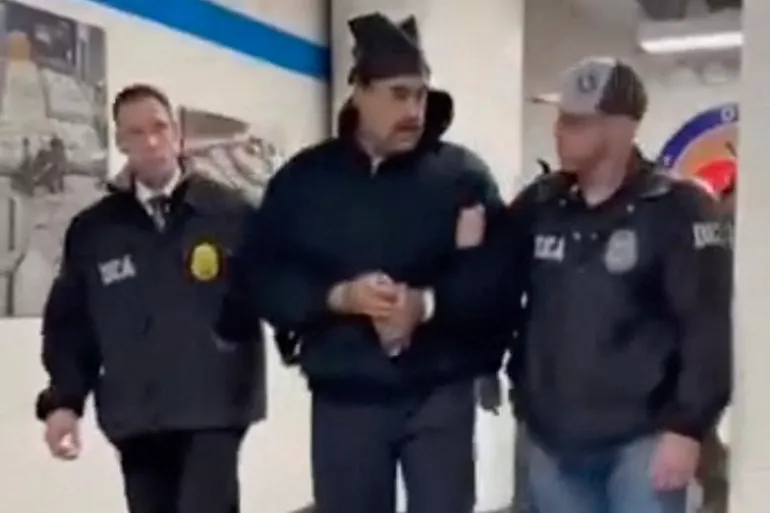
Venezuela’s political order was abruptly upended after the United States carried out Operation Absolute Resolve on January 3, 2026—an action Washington insists was a law-enforcement mission, but one that has triggered a seismic legal, political, and diplomatic backlash.
Within hours of the operation, U.S. authorities unveiled sweeping criminal charges against President Nicolás Maduro and his wife, Cilia Flores, while Caracas moved swiftly to install Vice President Delcy Rodríguez as acting head of state—marking the most dramatic transfer of power in Venezuela in decades.
U.S. Charges and a Sudden Shift in Caracas
U.S. Attorney General Pamela Bondi announced the unsealing of a superseding indictment in the Southern District of New York, accusing Maduro and Flores of narco-terrorism, cocaine importation conspiracies, and weapons offenses. Prosecutors allege a 25-year partnership with the Cartel de los Soles and foreign armed groups, including the FARC, aimed at flooding the United States with cocaine.
The charges culminate years of U.S. investigations and follow the State Department’s August 2025 decision to raise the reward for information leading to Maduro’s capture to $50 million. Maduro is expected to appear before Alvin Hellerstein in Manhattan on January 5.
In Caracas, Vice President Delcy Rodríguez assumed the role of acting president and was set to be formally sworn in Monday morning. While calling for “cooperation” and “respectful relations” with Washington, Rodríguez simultaneously condemned the U.S. operation as a violation of Venezuelan sovereignty.
Defense Minister Vladimir Padrino López said the operation resulted in military and civilian casualties, including during strikes on the Fuerte Tiuna complex in Caracas—claims that have fueled public anger and deepened uncertainty at home.
A Legal Test With Global Implications
The indictment represents one of the most expansive uses of U.S. narco-terrorism statutes against a sitting or recently deposed head of state. By asserting extraterritorial jurisdiction, the Justice Department argues that the alleged conduct directly targeted U.S. security interests.
Defense lawyers are expected to challenge the legality of Maduro’s capture, U.S. jurisdiction, and the admissibility of evidence obtained through intelligence and military means. Early rulings by Judge Hellerstein could set precedents redefining the boundary between international criminal enforcement and the use of military force.
Domestically, senior Democratic leaders Hakeem Jeffries and Chuck Schumer have rejected the administration’s framing of the operation as law enforcement, calling it an unauthorized act of war.
International Fallout
Global reaction has been swift and polarized. UN Secretary-General António Guterres warned that the operation risks setting a dangerous precedent and undermining the UN Charter’s protections of sovereignty.
Brazil, Chile, Colombia, Mexico, Uruguay, and Spain issued a joint statement condemning the U.S. action as a threat to regional stability, urging diplomacy over unilateral force.
As Maduro faces his first court appearance in New York, Venezuela’s interim leadership confronts a precarious balancing act—seeking legitimacy at home, managing public outrage, and navigating relations with Washington. The outcome may reshape not only Venezuela’s future, but the rules governing international power and accountability.