









The United States and Israel launched a large-scale joint military operation early Saturday against targets across Iran, marking one of the most significant escalations in regional hostilities in recent years.
The campaign, reportedly codenamed “Epic Fury” by U.S. officials and “Roaring Lion” by Israeli authorities, has already resulted in substantial civilian casualties and triggered retaliatory military actions across the Middle East, according to multiple international and regional media reports.
Strike on School in Minab
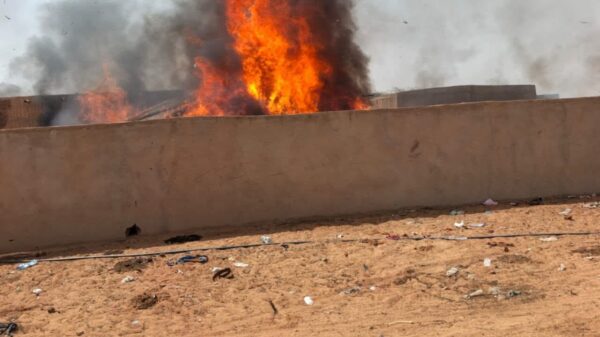
Among the most widely reported incidents was a strike on a girls’ primary school in the southern city of Minab, in Iran’s Hormozgan Province near the strategically important Strait of Hormuz.
Iran’s state broadcaster IRIB and Turkey’s Anadolu Agency reported that between 40 and 51 people were killed, including a large number of students. Other media outlets, including NDTV, initially reported lower figures, citing at least 24 students killed, reflecting the rapidly evolving situation and conflicting early casualty reports.
Local officials said the Shajareye Tayabeh girls’ school was directly hit. U.S. and Israeli authorities maintain that the operation targets military and nuclear infrastructure, noting that facilities linked to the Islamic Revolutionary Guard Corps (IRGC) are located within the city.
In a separate incident, Iran’s Mehr News Agency reported that at least two students were killed in another strike on a school east of Tehran.
Scope and Objectives of the Campaign
Officials and analysts describe the operation as significantly larger than the 12-day air conflict between Israel and Iran in June 2025.
According to statements attributed to U.S. and Israeli officials:
U.S. objectives include degrading Iran’s missile and nuclear capabilities and, according to some reports, facilitating political change within the country.
Israeli objectives focus on neutralizing what it describes as existential threats and conducting preemptive defensive operations.
Major urban centers reportedly struck include Tehran, Isfahan, Qom, Karaj, Tabriz, and Minab.
Reports also indicate that compounds associated with Supreme Leader Ali Khamenei and the Iranian presidential complex were among high-value targets, though independent verification remains limited.
Iranian Retaliation and Regional Impact
In response, the IRGC launched waves of missiles and drones targeting Israel and U.S. military facilities in the Gulf region.
Targets reportedly included sites associated with the U.S. Fifth Fleet in Bahrain and bases in Kuwait, Qatar, and the United Arab Emirates.
In the UAE, one civilian was reportedly killed in Abu Dhabi after being struck by shrapnel from an intercepted missile, according to local reports.
Several Gulf states, including the UAE, Iraq, Bahrain, and Qatar, have closed their airspace amid the escalating security situation. Foreign embassies, including India’s diplomatic mission, have advised their citizens to remain indoors.
Official Statements
U.S. President Donald Trump urged the Iranian population to “seize control of your destiny,” a statement Iranian officials described as provocative.
Iranian Foreign Minister Abbas Araghchi condemned the strikes as a violation of international law and described them as direct aggression against the Iranian people.
A Region on Edge
The unfolding conflict has raised fears of a broader regional war, particularly given the strategic importance of the Strait of Hormuz, through which a significant share of global oil supplies passes.
Analysts warn that further escalation could disrupt global energy markets, international aviation routes, and diplomatic stability across the Middle East.
As casualty figures continue to emerge and governments assess their next steps, the international community is closely monitoring developments in what could become one of the most consequential military confrontations in the region in decades.