
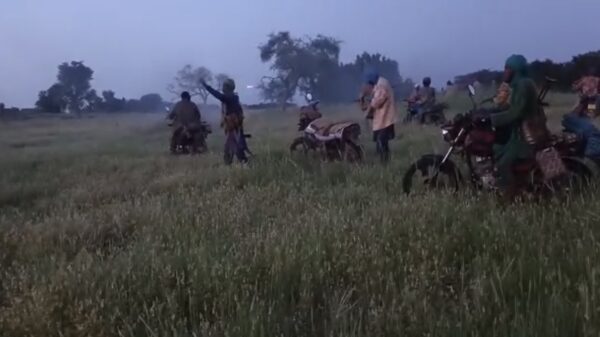







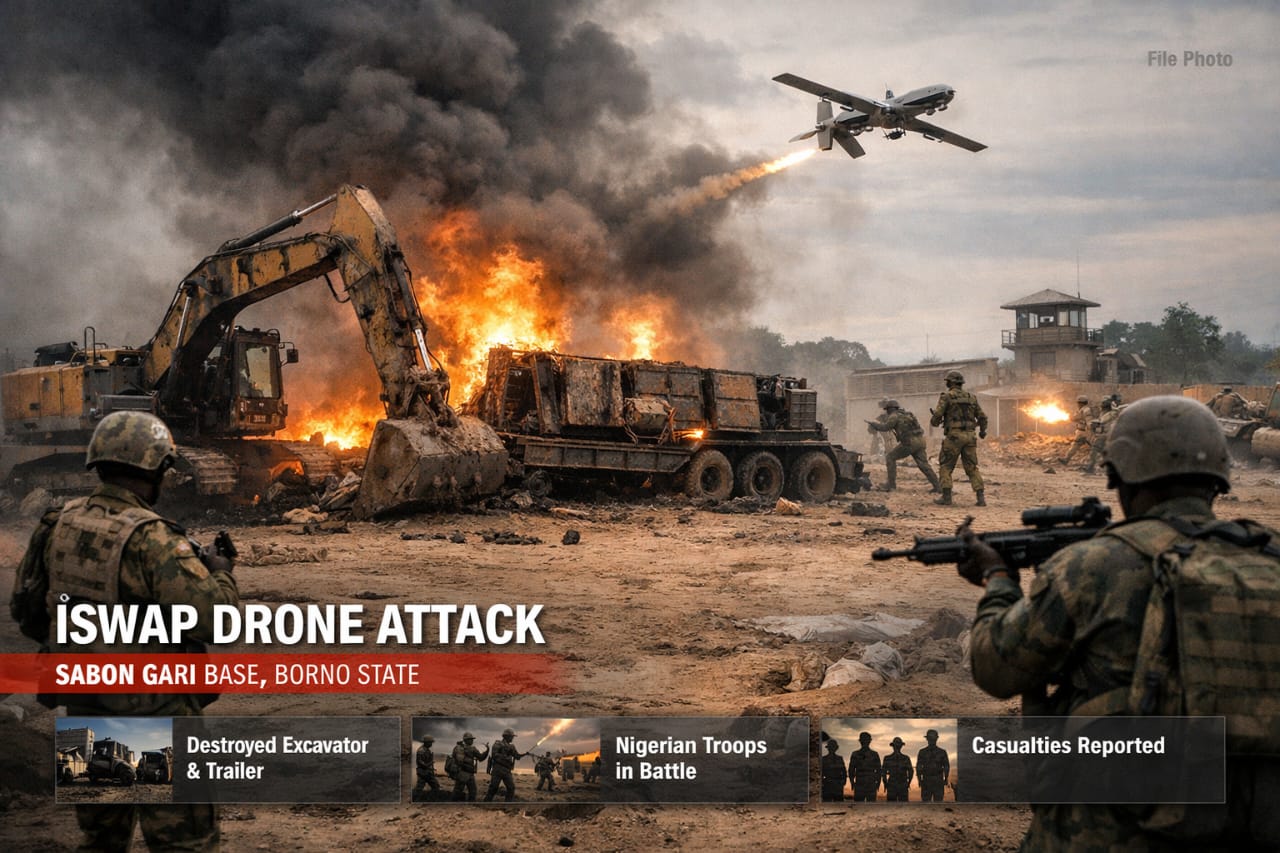
Militants of the Islamic State West Africa Province launched a coordinated pre-dawn assault on the Nigerian Army’s Sabon Gari military base in Borno State on Thursday, marking a significant escalation in insurgent tactics through the use of armed drones, according to official military statements and corroborated media reports.
Military sources clarified that the attack targeted the Sabon Gari base in Borno State under Sector 2 of Operation Hadin Kai, and not the similarly named location in Madagali, Adamawa State.
Drone-Assisted Breach of Military Perimeter
Speaking for the Joint Task Force in the North East, Lieutenant Colonel Sani Uba, spokesperson for Operation Hadin Kai, said the militants struck before dawn, combining drone-assisted aerial attacks with a multi-directional ground assault.
According to the official account, the deployment of armed drones enabled the attackers to temporarily breach the base’s perimeter. The aerial strikes destroyed key military equipment, including an excavator and a low-bed trailer located inside the facility.
Troops stationed at the base, reinforced by units from nearby formations, repelled the attackers after a prolonged firefight and successfully re-secured the position. A pursuit operation is under way to track fleeing insurgents, Uba said.
Casualties Reported by Security Sources
While the military confirmed that some personnel were killed, it did not release an official casualty figure. However, security sources cited by Reuters and Nigerian media reported that at least nine soldiers and two members of the Civilian Joint Task Force were killed.
Around sixteen additional personnel were wounded and are receiving medical treatment, according to the same sources.
Growing Concern Over Insurgent Drone Capabilities
The Nigerian military has voiced concern over what it described as a troubling pattern of drone use by ISWAP and Boko Haram in early 2026, pointing to an evolution in insurgent operational capabilities.
Earlier this month, troops operating in the Timbuktu Triangle repelled two drone-supported attacks during clearance operations on January 18. On January 16, another attack targeted Forward Operating Base Azir, where militants used rocket-propelled grenades to hit a CCTV control room and military transport vehicles.
Security Implications
Military analysts say the Sabon Gari attack highlights the increasing sophistication of insurgent tactics in northeastern Nigeria, particularly the use of modified or weaponized drones to support ground assaults and damage military infrastructure.
The Nigerian Armed Forces have reiterated their determination to counter the evolving threat and sustain pressure on insurgent groups operating across Borno State and the wider Lake Chad region.