










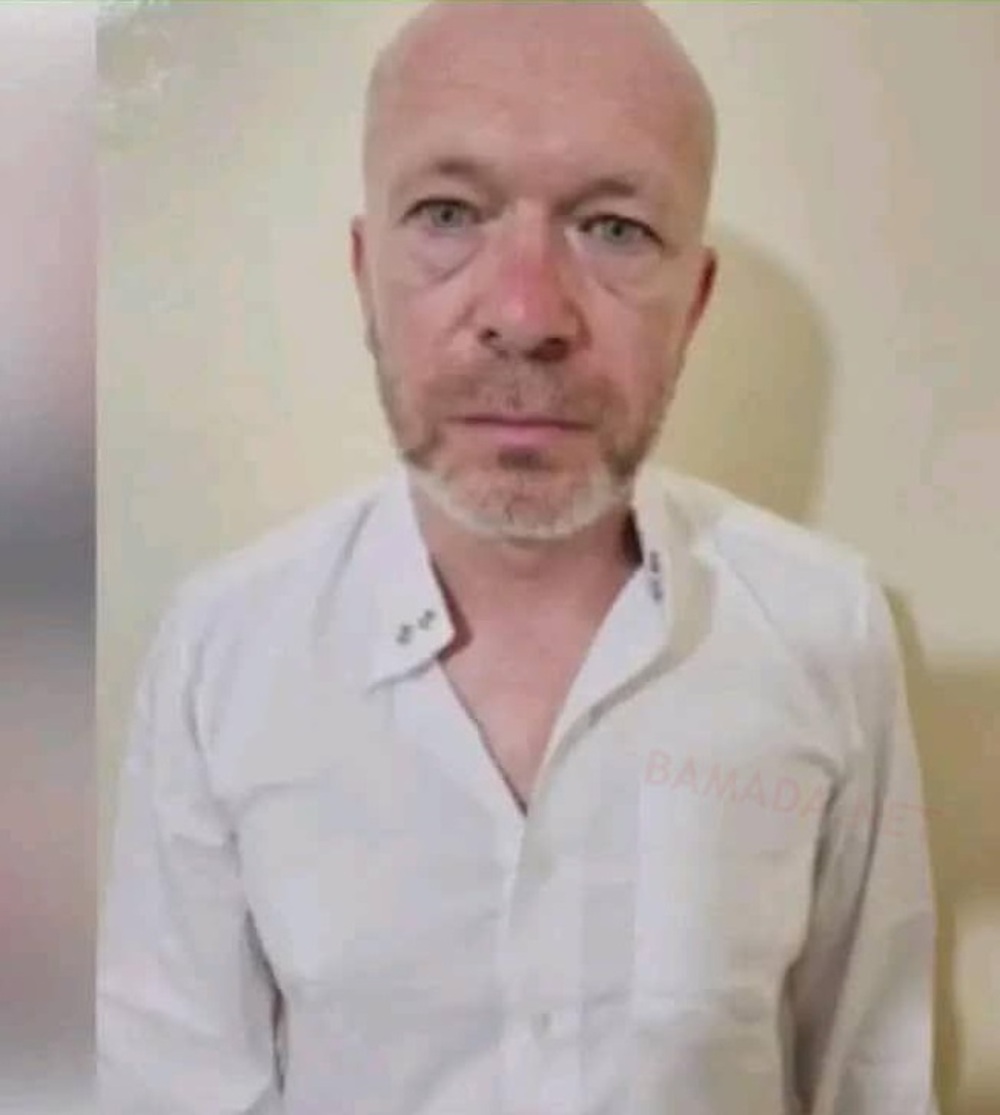
Mali’s government announced on Thursday that it had granted a presidential pardon to French national Yann Christian Bernard Vezilier, who was serving a 20-year prison sentence after being convicted of undermining the external security of the state.
The case had become a major source of tension between Bamako and Paris.
The government said transitional President General Assimi Goita issued Decree No. 0503/PT-RM granting the pardon, which is accompanied by Vezilier’s immediate removal from Malian territory.
The decision ends nearly a year of detention for the French national. It does not, however, overturn his conviction or erase the criminal responsibility that Malian authorities say was established by the court.
Convicted in alleged destabilisation case
Malian authorities arrested Vezilier alongside several Malian military officers in August 2025, accusing him of involvement in an alleged attempt to destabilise state institutions.
Bamako presented him as an operative working for French intelligence and alleged that he had established contacts with military officers and civilians as part of activities threatening Mali’s security and sovereignty.
On 5 June 2026, a court in Bamako sentenced him to 20 years in prison for undermining state security. He was also banned from residing in Mali for 20 years and ordered to pay a fine.
France rejected the allegations as “unfounded”, saying Vezilier worked at its embassy in Bamako as part of a security cooperation mission and had not participated, directly or indirectly, in any attempt to destabilise Mali.
Pardon does not overturn conviction
Government spokesman Brigadier General Issa Ousmane Coulibaly said the pardon did not call into question the facts that, according to the Malian authorities, were established during a trial in which the defendant was able to exercise his right to a defence.
The government described the decision as an act of executive clemency rather than a reversal of the judicial ruling. Vezilier’s immediate expulsion from the country forms part of its implementation.
Bamako also maintained that the case had been heard by an independent court in accordance with state sovereignty and the separation of powers.
Quiet diplomatic mediation
The Malian government said the good offices of an unnamed “brotherly country” had contributed to securing the pardon.
It praised what it described as discreet mediation conducted with strict respect for Mali’s sovereignty, indicating that diplomatic negotiations had taken place away from public attention.
French media reports identified Morocco as having played a key role in the mediation, although the official Malian statement did not name the country concerned.
The authorities presented the pardon as an expression of Mali’s commitment to peace and dialogue, as well as what they described as the country’s ancestral values of forgiveness, hospitality and dignity.
For Vezilier, the decision means freedom and a return home after months in detention. Politically, it marks a limited easing of one of the most sensitive disputes between Mali and France.
Strained relations between Bamako and Paris
Relations between Mali and France have deteriorated sharply since the military took power following coups in 2020 and 2021. Bamako subsequently ended military cooperation with Paris, and French forces withdrew from the country.
Tensions deepened following Vezilier’s arrest. France suspended part of its security cooperation and called for his release, while Mali insisted that the proceedings were a matter of national sovereignty.
The pardon does not necessarily signal a full restoration of bilateral relations, but it removes a significant humanitarian and diplomatic obstacle and could create space for further engagement.
Mali’s government stressed that the measure would have no effect on other judicial proceedings under way in the country, which it said would continue independently.